Warehouse Racking shapes storage density, picking speed, worker movement, and long-term warehouse costs. It is not merely steel arranged beside a loading bay. A poorly selected system can create blocked aisles, unused vertical space, and slower order fulfillment.
MHI’s 2024 Annual Industry Report found that 55% of surveyed supply-chain professionals planned to increase technology investment. That pressure makes storage design more important. According to the report, digital tools and automation are expanding across warehouses. Yet automation cannot repair an unsuitable rack layout. The floor still matters.
David J. Piasecki, warehouse operations author and consultant, states, “There is no one-size-fits-all solution in warehousing.” His point remains practical. Selective pallet racking may support fast access and flexible stockkeeping units. Drive-in racking can improve density, but it reduces direct pallet access. Double-deep, push-back, pallet-flow, cantilever, and automated systems each solve different problems.
The right choice depends on pallet weight, product dimensions, turnover, aisle width, ceiling height, equipment, and safety procedures. Very narrow aisles may increase capacity, but they can demand specialized trucks and tighter operating discipline. That trade-off is easy to underestimate.
This guide compares the top types of Warehouse Racking and their practical applications. It also considers capacity, accessibility, installation demands, and future adaptability. The framework is useful, but not perfect. Real warehouses contain damaged pallets, seasonal peaks, uneven floors, and rushed decisions. Those details often decide whether a racking plan succeeds.
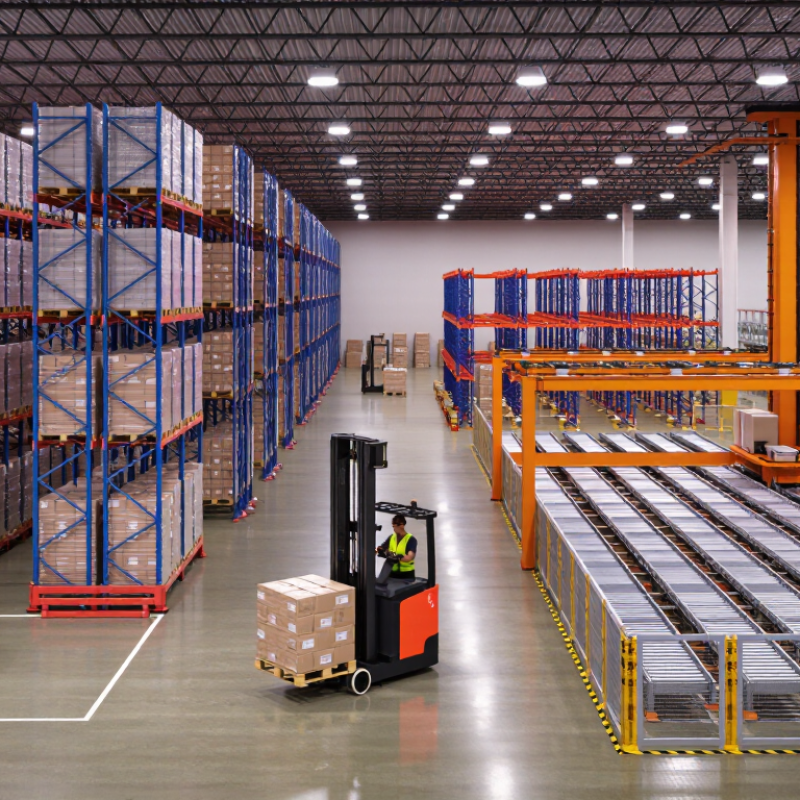
What Are the Top Types of Warehouse Racking?
Warehouse racking is a steel storage structure designed to hold pallets, cartons, or long materials above the floor. It uses vertical space while keeping products accessible for picking and replenishment. Not merely storage. In practical warehouse planning, rack selection depends on product size, turnover, pallet weight, aisle width, and handling equipment. The U.S. Census Bureau reported that e-commerce represented 15.6% of U.S. retail sales in 2023. That volume increases pressure on storage density and order speed.
Selective pallet racking remains common because forklifts can reach every pallet directly. Drive-in racking stores more pallets in fewer aisles, but it suits stable products with limited stock rotation. Double-deep systems improve density, although they may reduce immediate access. Carton-flow racks support manual picking with inclined rollers. Cantilever racks are better for pipes, timber, and other long loads. Each design solves a different problem. None is perfect.
Racking also supports safer, more measurable operations. Clear labeling, load plaques, protected uprights, and regular inspections reduce avoidable handling risks. OSHA’s material-handling guidance requires stored materials to remain stable and not create hazards. A layout can look efficient on paper, yet fail when forklifts turn too tightly or workers restock during peak picking periods. That weakness deserves review. Real performance comes from matching rack geometry with daily movement, not simply maximizing pallet positions.
| Racking Type | How It Works | Typical Storage Density | Pallet Accessibility | Best Suited For | Main Advantages | Key Considerations |
|---|---|---|---|---|---|---|
| Selective Pallet Racking | Individual pallets are stored on adjustable horizontal beams in parallel aisles. | Low to medium | Direct access to every pallet | Warehouses with many stock-keeping units and frequent product changes | Flexible layout, easy stock rotation, and simple inventory control | Uses more aisle space than high-density systems |
| Drive-In Racking | Forklifts enter storage lanes to place pallets on rails supported by upright frames. | High | Limited; generally follows last-in, first-out rotation | Large quantities of the same product with low picking frequency | Maximizes floor-space utilization by reducing aisles | Requires careful forklift operation and compatible, stable loads |
| Drive-Through Racking | Forklifts can enter the rack from both ends, allowing loading from one side and unloading from the other. | High | Access from both ends; supports first-in, first-out rotation when managed correctly | High-volume goods requiring better rotation than drive-in storage provides | High density with improved product flow | Costs more floor space than drive-in racking because both ends require access |
| Push-Back Racking | Pallets sit on nested carts or inclined rails and move backward as new pallets are loaded. | Medium to high | One aisle-facing side; typically last-in, first-out | Multiple pallets per product with moderate turnover | Good density with faster loading and retrieval than drive-in systems | Not ideal for strict first-in, first-out inventory rotation |
| Pallet Flow Racking | Pallets move by gravity on rollers from the loading side to the picking side. | High | Separate loading and picking faces; supports first-in, first-out | Perishable products and goods requiring controlled stock rotation | Efficient replenishment, clear product flow, and reduced handling | Higher installation cost and stricter pallet-quality requirements |
| Double-Deep Racking | Two pallet positions are placed one behind the other, usually requiring a reach truck. | Medium to high | Direct access to the front pallet; rear pallets have restricted access | Facilities storing several pallets per product with moderate variety | Increases storage capacity without eliminating all selectivity | Requires compatible handling equipment and careful inventory planning |
| Cantilever Racking | Horizontal arms extend from vertical columns to support long or irregular loads. | Medium | Open front access | Lumber, pipes, profiles, furniture, and other lengthy materials | No front columns obstruct the load, making long items easier to handle | Needs adequate aisle width and careful load distribution |
| Carton Flow Racking | Cartons move along inclined rollers or wheels from the replenishment side to the picking side. | Medium to high | Front-facing access with automatic product presentation | Small-item picking, order fulfillment, and high-volume case handling | Supports first-in, first-out rotation and reduces picker travel | Best for uniform cartons; lanes require periodic inspection and replenishment |
| Mezzanine Racking | A raised structural platform creates an additional usable storage or work level above the floor. | High vertical utilization | Depends on the shelving or pallet system installed on each level | Warehouses with sufficient clear height and limited floor area | Adds storage or operating space without expanding the building footprint | Requires structural review, safe access, guarding, and compliance with local codes |
Warehouse racking is a structural storage system designed to organize goods vertically, increase available capacity, improve inventory access, and support safer material handling. The appropriate system depends on product dimensions, pallet weight, stock-rotation requirements, handling equipment, available floor area, and building height.
Warehouse racking stores pallets, cartons, or long materials above the floor. It uses vertical space and keeps goods accessible.
Selective pallet racking allows forklifts to reach each pallet directly. It suits warehouses with many product lines and frequent picking.
Drive-in racking suits stable products with limited stock rotation. It stores many pallets in fewer aisles, but access is less immediate.
Cantilever racking suits pipes, timber, metal profiles, and similar loads. Its open front makes loading long items easier.
Consider pallet size, load weight, product turnover, ceiling height, and handling equipment. A clean layout drawing is not enough.
Keep loads stable and heavier pallets on lower levels. Inspect beams, uprights, locking pins, labels, and protective guards regularly.
Forklifts need enough room to turn, lift, and pass safely. Narrow aisles may increase storage density but slow movement.
Yes. Test it with real pallets and actual equipment. This can reveal blocked views, awkward turns, or unsafe reaching distances.
Not always. Adjustable systems support change, but poor records can create confusion. I would review product changes before moving beams.
Include installation, inspections, repairs, expansion, equipment needs, and lost productivity during changes. The cheapest layout may become expensive later.
Warehouse Racking is a structured storage system designed to organize products, improve space utilization, and support efficient warehouse operations. It helps businesses store goods vertically, maintain clearer inventory locations, and speed up receiving, picking, and shipping processes. Common types include selective pallet racking, drive-in racking, push-back racking, pallet flow racking, cantilever racking, and mobile racking. Each system works differently: selective racks provide direct access to individual pallets, drive-in racks maximize density, flow racks use gravity for organized movement, cantilever racks suit long or irregular items, and mobile racks reduce wasted aisle space.
Choosing the right racking system depends on product size, weight, storage volume, access frequency, available floor area, budget, and inventory rotation requirements. For safe and efficient use, warehouses should select suitable load capacities, inspect equipment regularly, keep aisles clear, distribute loads evenly, and train employees in proper handling procedures. Clear labeling, appropriate forklift operation, and routine maintenance also help reduce risks while improving productivity and storage accuracy.

 Jinhui Storage Equipment